Some links on this page are affiliate links. We may earn a commission if you buy through them, at no extra cost to you. Paid prep is optional and does not guarantee a result.
A Pipefitter Aptitude Test may be used by a union-management committee, local apprenticeship program, contractor association, employer, training center, or other apprenticeship sponsor. Some programs also recruit steamfitters through the same or a related process. There is no single entrance test used by every program.
Some sponsors use written or computerized aptitude tests. Others may use interviews, document screening, prior education, physical requirements, or a different process. Possible test areas include mathematics, reading comprehension, mechanical reasoning, and spatial reasoning. The exact process depends on the local, sponsor, jurisdiction, and recruitment cycle.
The questions on this page are original practice-style exercises. They are not official United Association, GAN Human Resources, JATC, union-local, apprenticeship-sponsor, NCCER, Red Seal, employer, government, or test-provider questions. Always follow the current application notice and candidate instructions issued by your intended apprenticeship program.
General mechanical aptitude practice on AptitudeTests.org can help you build broad skills in gears, pulleys, levers, hydraulics, and basic circuits before you narrow your review to pipefitter-specific topics. It is independent general mechanical aptitude preparation. It does not reproduce every local’s Pipefitter Aptitude Test, and no general mechanical resource can substitute for your local’s exact official notice and candidate instructions.
JobTestPrep offers third-party Pipefitter and Steamfitter aptitude-test preparation associated with the GAN Human Resources format. Its product details describe its own commercial preparation and do not define a universal official apprenticeship examination. Confirm the current price, access period, and included materials on the live product page before purchase.
For additional timed practice after you review the official invitation and format notes below, Review JobTestPrep’s US Pipefitter and Steamfitter aptitude preparation.
What Is the Pipefitter Aptitude Test?
The Pipefitter Aptitude Test is a possible applicant-screening assessment. It evaluates foundational academic and reasoning skills. It is not a practical pipefitting examination. It is not a journey-level certification. It is not an NCCER assessment. It is not a Red Seal examination. It is not used by every apprenticeship sponsor.
JobTestPrep’s product is a third-party preparation resource, not an official examination specification.
Is There One Official Pipefitter Test?
No.
Requirements vary according to United Association local, joint apprenticeship committee, contractor association, employer, training center, state, province, country, pipefitter or steamfitter classification, recruitment cycle, and testing provider.
Candidates should verify the exact sponsor, local number, program title, application dates, minimum qualifications, required documents, whether an aptitude test is required, exact test provider, sections, duration, question count, calculator policy, supplied formulas or conversion tables, passing or ranking rules, interview process, physical or practical stages, retest policy, and accommodations. This page does not provide universal answers for those items.
What Does a Pipefitter or Steamfitter Do?
BLS and O*NET provide broad occupational context. Potential high-level points include installing or maintaining piping systems; interpreting plans or specifications; measuring materials; assembling piping components; inspecting systems; troubleshooting problems; maintaining work records; coordinating with other workers; and using mathematics, mechanical reasoning, and accurate measurement.
This section is descriptive only. It does not provide instructions for performing pipefitting or steamfitting work. Real trade work requires qualified supervision, current codes, employer procedures, and formal training.
Pipefitter vs Steamfitter
Both work with piping systems. Steamfitters commonly specialize in piping systems designed for high-pressure liquids or gases. Some apprenticeship programs combine these trades. Other programs recruit them separately. Exact classifications depend on the sponsor. Do not claim that every program uses the same entrance test.
Pipefitter vs Plumber
Plumbers often work with water, waste, gas, and fixture systems in residential, commercial, or industrial settings. Pipefitters often work with industrial or commercial piping systems. Duties may overlap in some workplaces. Apprenticeship programs and entrance assessments may remain separate. See the Plumber Aptitude Test guide when your notice is plumber-specific.
Pipefitter vs Sprinkler Fitter
Sprinkler fitting may be a separate classification or apprenticeship program. Do not assume identical admission requirements. Always follow the official notice for the specific program.
Apprenticeship Test vs NCCER Pipefitter Test
An apprenticeship aptitude test screens applicants before or near entry into training. An NCCER assessment concerns a separate curriculum, credential, or skilled-trade evaluation. JobTestPrep’s Pipefitter Apprentice Exam PrepPack expressly does not cover the NCCER Pipefitter test. Do not merge the two intents.
Apprenticeship Test vs Red Seal Steamfitter/Pipefitter Exam
Red Seal examinations concern Canadian trade certification. They are not the same as a pre-apprenticeship aptitude assessment. This page does not prepare candidates for Red Seal examinations.
Aptitude Test vs Journeyman Examination
The aptitude test concerns applicant selection. Journey-level examinations occur after substantial training or experience. This page does not target journey-level licensing or certification.
Pipefitter vs Boilermaker
Both are skilled metal trades. Pipefitters primarily work with piping systems. Boilermakers work with boilers, tanks, vats, and other large vessels. Aptitude-test topics may overlap, but the occupational and preparation intents remain distinct. See the Boilermaker Apprenticeship Test guide for the boilermaker intent.
U.S. vs Canadian Programs
Apprenticeship governance and application processes differ by country and region. Do not merge provincial Canadian requirements with U.S. local procedures. Use the exact current notice for the jurisdiction and sponsor that apply to you.
Safety Boundary for Practice Content
This article does not teach or provide instructions for cutting pipe; threading pipe; welding; brazing; soldering; pressure testing; gas-line work; valve installation; high-pressure systems; steam-system operation; chemical piping; refrigerant handling; medical-gas piping; rigging; crane signals; confined-space work; lockout or tagout; hot work; hazardous-material handling; power-tool use; blueprint-based installation; real plumbing-code compliance; or emergency repair procedures.
Practice questions use abstract, classroom-style aptitude scenarios. Safety-related judgment items emphasize following formal training, staying within assigned authority, stopping when instructions are unclear, requesting qualified supervision, and not improvising a hazardous procedure.
Common Possible Assessment Areas
The areas below cover foundational skills that may be relevant and subjects covered by the current JobTestPrep PrepPack. They are not confirmed official subjects for every local.
Basic Arithmetic
Addition, subtraction, multiplication, division, signed numbers, order of operations, estimation, and averages.
Fractions and Decimals
Simplifying fractions, equivalent fractions, mixed numbers, fraction operations, decimal operations, conversions, and comparing numerical values.
Percentages, Ratios, and Proportions
Percentages, percentage change, ratios, proportions, rates, and scale problems.
Algebra
One-step and two-step equations, expression simplification, formula substitution, inequalities, number patterns, and word problems.
Measurement and Unit Conversion
Length, area, volume, time, imperial units, metric units, supplied conversion tables, and scale interpretation. All conversion factors needed for practice items are supplied in the question.
Geometry
Perimeter, area, volume, angles, radius, diameter, circumference, simple triangles and rectangles, and basic coordinate reasoning. Formulas are supplied when needed.
Mechanical Reasoning
Abstract principles such as gears, levers, pulleys, torque, friction, force, pressure, mechanical advantage, balance, and simple electrical circuits. Not operational pipefitting instruction.
Spatial Reasoning and Figure Visualization
Shape rotation, matching views, folded shapes, nets, orientation, joining simple fictional pieces, and identifying an object after repositioning.
Blueprint and Isometric Reading
Reading a simple isometric sketch, matching it to the correct set of standard views, reading a drawing scale note, reading elevation labels, and using a supplied legend to identify symbols. This is abstract print-reading aptitude, not blueprint-based installation instruction.
Reading Comprehension
Main idea, stated detail, sequence, purpose, supported conclusion, exception, vocabulary in context, and restating a sentence accurately.
Following Written Directions
Applying supplied conditions, following a sequence, recognizing an exception, identifying missing information, selecting the next supported step, and requesting clarification when appropriate.
Tables and Data Interpretation
Locating values, totals, averages, percentage changes, comparing records, interpreting supplied conversion tables, and selecting supported conclusions.
Basic Passage-Based Science
Safe general topics such as pressure, volume, temperature, states of matter, force, density, and energy when all facts and formulas are supplied. Chemistry knowledge is not required for the practice set below, and JobTestPrep’s current PrepPack states that chemistry questions are not included.
Pipefitter Aptitude Practice Questions
This JobPracticeTests practice set includes 30 original questions. Any informal timing you apply is JobPracticeTests-only and is not an official sponsor format. The questions are grouped into six aptitude-style categories: trade arithmetic, fractions and measurement, geometry and spatial reasoning, mechanical reasoning, blueprint and isometric reading, and safety and instruction following. Answer each item from the information supplied.
Trade Arithmetic
Question 1: Arithmetic
What is 84 - 39?
- A. 55
- B. 45
- C. 35
- D. 43
Answer and Explanation
Correct answer: B
84 - 39 = 45.
Question 2: Order of Operations
Evaluate: 9 + 3 x 4.
- A. 48
- B. 21
- C. 36
- D. 15
Answer and Explanation
Correct answer: B
Multiply first: 3 x 4 = 12. Then 9 + 12 = 21.
Question 3: Percentage of a Quantity
What is 30% of 90?
- A. 18
- B. 30
- C. 36
- D. 27
Answer and Explanation
Correct answer: D
0.30 x 90 = 27.
Question 4: Percentage Change
A fictional total rose from 40 to 50. What was the percentage increase?
- A. 20%
- B. 10%
- C. 30%
- D. 25%
Answer and Explanation
Correct answer: D
Increase = 10. 10 / 40 = 0.25 = 25%.
Question 5: Estimation
Which is the best estimate of 48 x 21?
- A. About 500
- B. About 1,500
- C. About 200
- D. About 1,000
Answer and Explanation
Correct answer: D
50 x 20 = 1,000 is the closest estimate.
Fractions and Measurement
Question 6: Fraction Simplification
Simplify 16/24.
- A. 3/4
- B. 2/3
- C. 4/6
- D. 8/12
Answer and Explanation
Correct answer: B
Divide numerator and denominator by 8: 2/3.
Question 7: Fraction Addition
What is 1/4 + 3/8?
- A. 4/12
- B. 1/2
- C. 5/8
- D. 7/8
Answer and Explanation
Correct answer: C
1/4 = 2/8. 2/8 + 3/8 = 5/8.
Question 8: Fraction Multiplication
What is 2/3 x 3/5?
- A. 2/5
- B. 5/8
- C. 6/15
- D. 1/5
Answer and Explanation
Correct answer: A
2/3 x 3/5 = 6/15 = 2/5.
Question 9: Decimal Operations
What is 2.75 + 1.4?
- A. 3.15
- B. 4.15
- C. 4.05
- D. 3.05
Answer and Explanation
Correct answer: B
2.75 + 1.40 = 4.15.
Question 10: Length Conversion
Use the supplied conversion: 12 inches = 1 foot.
How many inches are in 2.5 feet?
- A. 24
- B. 36
- C. 20
- D. 30
Answer and Explanation
Correct answer: D
2.5 x 12 = 30 inches.
Geometry and Spatial Reasoning
Question 11: Area
Formula: Area of a rectangle = length x width.
What is the area of a rectangle 7 ft by 5 ft?
- A. 12 sq ft
- B. 24 sq ft
- C. 35 sq ft
- D. 40 sq ft
Answer and Explanation
Correct answer: C
7 x 5 = 35 square feet.
Question 12: Perimeter
Formula: Perimeter of a rectangle = 2(length + width).
What is the perimeter of a rectangle 8 m by 3 m?
- A. 24 m
- B. 22 m
- C. 11 m
- D. 26 m
Answer and Explanation
Correct answer: B
2(8 + 3) = 2 x 11 = 22 m.
Question 13: Volume
Formula: Volume of a rectangular solid = length x width x height.
What is the volume of a solid 6 cm by 2 cm by 4 cm?
- A. 12 cubic cm
- B. 24 cubic cm
- C. 32 cubic cm
- D. 48 cubic cm
Answer and Explanation
Correct answer: D
6 x 2 x 4 = 48 cubic centimeters.
Question 14: Angles
Two angles form a straight line. One measures 130 degrees.
What is the other angle?
- A. 50 degrees
- B. 60 degrees
- C. 40 degrees
- D. 70 degrees
Answer and Explanation
Correct answer: A
180 - 130 = 50 degrees.
Question 15: Rotation
A flat arrow points RIGHT.
After a 90-degree clockwise rotation in the plane, which way does it point?
- A. Right
- B. Left
- C. Up
- D. Down
Answer and Explanation
Correct answer: D
Clockwise: right becomes down.
Mechanical Reasoning
Question 16: Gears
Two meshed gears turn against each other.
If Gear A turns clockwise, which way does Gear B turn?
- A. Clockwise
- B. Neither turns
- C. Counterclockwise
- D. Both turn clockwise
Answer and Explanation
Correct answer: C
Meshed gears reverse direction.
Question 17: Pulley Direction
A fixed pulley redirects a rope.
If you pull down on the free end, which way does the load move?
- A. Down
- B. Sideways only
- C. It stays fixed
- D. Up
Answer and Explanation
Correct answer: D
Pulling down on a fixed pulley raises the load.
Question 18: Lever Advantage
On a class-1 lever, the fulcrum is between effort and load.
If the effort arm becomes longer while the load arm stays the same, what happens to the effort needed for the same load?
- A. It increases
- B. It decreases
- C. It becomes infinite
- D. It becomes zero always
Answer and Explanation
Correct answer: B
A longer effort arm increases mechanical advantage, so less effort is needed.
Question 19: Torque
Torque increases when force is applied farther from the pivot, if force stays the same.
Which setup produces more torque with equal force?
- A. Force 3 cm from the pivot
- B. Force at the pivot
- C. Force 0 cm from the pivot
- D. Force 12 cm from the pivot
Answer and Explanation
Correct answer: D
Greater distance from the pivot produces greater torque.
Question 20: Pressure
Supplied relationship: Pressure = Force / Area.
If force = 90 N and area = 15 square meters, what is the pressure?
- A. 6 N per square meter
- B. 75 N per square meter
- C. 105 N per square meter
- D. 1,350 N per square meter
Answer and Explanation
Correct answer: A
90 / 15 = 6 N per square meter.
Blueprint and Isometric Reading
Question 21: Isometric View Matching
The isometric sketch below shows a simple L-shaped support bracket, similar in style to the top/front/right matching tasks used on some print-reading and spatial-aptitude assessments.
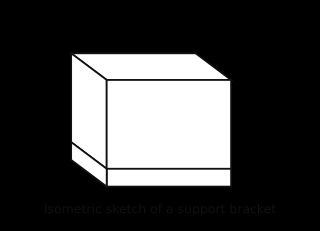
For a solid to be the correct match to an isometric sketch like this one, what must be true?
- A. Only the front face needs to match
- B. The solid must be consistent with the top, front, and right views all at once, not just one of them
- C. Isometric sketches never need to match any standard view
- D. Any solid with the same volume is automatically a match
Answer and Explanation
Correct answer: B
A correct match must be consistent with every standard view shown for the sketch at the same time. A solid that matches only one view but not the others is not the correct match.
Question 22: Blueprint Legend and Symbol Count
The practice pipe-run sketch below includes a legend showing that an open circle represents a flanged joint and a filled dot represents an elbow bend.
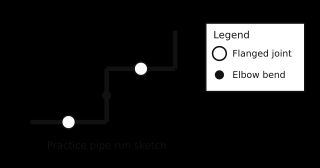
Based on the legend, how many flanged joints appear in the sketch?
- A. 0
- B. 1
- C. 2
- D. 3
Answer and Explanation
Correct answer: C
The legend shows an open circle for a flanged joint. The sketch shows two open-circle symbols along the pipe run, so there are 2 flanged joints.
Question 23: Scale Reading
A drawing includes the scale note: 1/4 inch = 1 foot. A pipe run measures 3 inches on the drawing.
What is the actual length of that pipe run?
- A. 3 feet
- B. 6 feet
- C. 12 feet
- D. 15 feet
Answer and Explanation
Correct answer: C
Each 1/4 inch on the drawing represents 1 foot, so 1 inch represents 4 feet. 3 inches x 4 feet per inch = 12 feet.
Question 24: Elevation Rise
Two elevation labels on a fictional drawing read EL 100’-0" and EL 106’-0".
What is the rise in elevation between these two labeled points?
- A. 4 feet
- B. 6 feet
- C. 10 feet
- D. 100 feet
Answer and Explanation
Correct answer: B
106’-0" - 100’-0" = 6 feet.
Question 25: Diameter Callout
A fictional isometric drawing includes a callout: NOMINAL DIAMETER: 6 in. Using the supplied formula Circumference = pi x diameter, with pi = 3.14, what is the approximate circumference?
- A. 9.42 in
- B. 12.56 in
- C. 18.84 in
- D. 37.68 in
Answer and Explanation
Correct answer: C
3.14 x 6 = 18.84 in.
Safety and Instruction Following
Question 26: Reading Main Idea
Fictional Training Center Notice
Applicants must submit Packet PF-1 and a government-issued photo ID by 3:00 p.m. on the filing date. Packets received after 3:00 p.m. are held for the next cycle. Incomplete packets are returned without scoring. Email uploads are accepted only when the subject line includes the applicant code. Interview notices are posted only after written scoring is finished.
What is the main purpose of the notice?
- A. To explain application packet rules
- B. To list tool prices
- C. To cancel all interviews
- D. To assign job sites
Answer and Explanation
Correct answer: A
The notice explains how and when application packets must be submitted.
Question 27: Reading Detail
Using the same Fictional Training Center Notice above, by what time must Packet PF-1 be submitted on the filing date?
- A. Noon
- B. 3:00 p.m.
- C. Midnight
- D. 9:00 a.m.
Answer and Explanation
Correct answer: B
The notice requires submission by 3:00 p.m.
Question 28: Following Several Steps
Required order: verify ID, collect Packet PF-1, stamp receipt.
Which sequence is correct?
- A. collect Packet PF-1, verify ID, stamp receipt
- B. stamp receipt, verify ID, collect Packet PF-1
- C. verify ID, collect Packet PF-1, stamp receipt
- D. collect Packet PF-1, stamp receipt, verify ID
Answer and Explanation
Correct answer: C
Only choice C preserves the required order.
Question 29: Reading Exception
Using the same Fictional Training Center Notice from Question 26, which packet would NOT meet the stated requirements?
- A. A complete packet with Packet PF-1 and photo ID submitted at 2:00 p.m.
- B. A packet missing photo ID
- C. A complete packet emailed with the applicant code in the subject line before 3:00 p.m.
- D. A complete packet submitted at 1:30 p.m.
Answer and Explanation
Correct answer: B
Missing photo ID makes the packet incomplete.
Question 30: Recognizing an Exception
Rule: Route Packet Orange to Room 2 unless it is marked Confidential.
A Confidential Packet Orange arrives. The rule does not say where Confidential packets go.
What is the best next step?
- A. Send it to Room 2 anyway
- B. Ask a supervisor for the Confidential routing instruction before moving the packet
- C. Leave it in a public hallway
- D. Destroy the packet
Answer and Explanation
Best answer: B
When the exception removes the usual route and no replacement route is supplied, seek qualified clarification rather than guessing or improvising.
Practice Answer Key
- B
- B
- D
- D
- D
- B
- C
- A
- B
- D
- C
- B
- D
- A
- D
- C
- D
- B
- D
- A
- B
- C
- C
- B
- C
- A
- B
- C
- B
- B
How to Score This Practice Test
Mark each miss, then group misses by skill type for this unofficial practice set. Rebuild accuracy in those groups before chasing speed. Nothing on this page is an official score, percentile, or prediction of referral.
This scoring guide applies only to the 30 unofficial practice questions on this page. It is not an official United Association, GAN Human Resources, JATC, local-union, apprenticeship-program, passing, ranking, interview, apprenticeship-offer, Red Seal, NCCER, or employment result.
How to Prepare for the Pipefitter Aptitude Test
- Identify the exact apprenticeship sponsor and local.
- Find the current official application notice.
- Confirm whether an aptitude test is required.
- Identify the test provider when disclosed.
- Review the officially listed sections.
- Practise arithmetic.
- Review fractions and decimals.
- Practise percentages, ratios, and proportions.
- Review algebra.
- Practise measurement and conversions.
- Review geometry formulas.
- Practise safe abstract mechanical reasoning.
- Practise spatial visualization.
- Practise blueprint and isometric reading, including scale notes and elevation labels.
- Improve reading comprehension.
- Practise following supplied directions.
- Build accuracy before increasing speed.
- Complete mixed timed practice.
- Prepare separately for interviews, documents, physical stages, or later trade assessments.
- Follow all official candidate instructions.
Verify sponsor and local, application dates, eligibility requirements, required documents, exact test provider, sections, question count, duration, calculator rules, conversion tables, supplied formulas, passing or ranking rules, interview process, physical or practical stages, retest policy, and accommodations with the official source. Do not invent these details.
Common Mistakes
- Assuming every UA local uses the same test
- Treating JobTestPrep as the official examination source
- Assuming every test is administered by GAN Human Resources
- Assuming all tests contain exactly four sections
- Assuming calculators are always prohibited
- Assuming 75% is a universal passing score
- Assuming all candidates are ranked in the same manner
- Assuming every unsuccessful candidate waits twelve months
- Conflating U.S. and Canadian programs
- Confusing Pipefitter and Plumber apprenticeship tests
- Confusing the aptitude test with NCCER
- Confusing the aptitude test with Red Seal certification
- Confusing the aptitude test with a journeyman examination
- Studying operational pipefitting procedures instead of aptitude skills
- Converting units in the wrong direction
- Failing to simplify fractions
- Rushing algebra
- Reversing gear direction
- Overlooking labels in spatial questions
- Matching only one view instead of checking every view of an isometric sketch at once
- Miscounting symbols on a supplied legend
- Adding outside assumptions to reading questions
- Treating a practice score as an apprenticeship prediction
Free vs Paid Preparation
Free preparation may help candidates understand possible assessment areas, review mathematics, try mechanical-reasoning questions, practise spatial and blueprint-reading skills, improve reading comprehension, and identify weak areas.
General mechanical aptitude practice on AptitudeTests.org is a useful independent starting point for broad mechanical-reasoning review. It does not reproduce any local’s specific Pipefitter Aptitude Test content.
Paid preparation built specifically around the GAN Human Resources Pipefitter format may be useful for candidates seeking structured mathematics practice, repeated numerical drills, mechanical aptitude practice, spatial-reasoning exercises, timed tests, detailed explanations, study guides, and progress reports. Paid prep does not guarantee improvement, passing, ranking, apprenticeship admission, or employment.
JobTestPrep and AptitudeTests.org are independent third-party preparation providers. Neither is the United Association, GAN Human Resources, a local union, JATC, apprenticeship sponsor, NCCER, Red Seal authority, employer, government agency, or official test administrator.
Official and Occupational Resources
- U.S. Bureau of Labor Statistics - Plumbers, Pipefitters, and Steamfitters
- O*NET - Plumbers, Pipefitters, and Steamfitters
- United Association - Apprenticeship
- Apprenticeship.gov - Apprenticeship Finder
BLS and O*NET provide occupational context. The United Association page provides general apprenticeship information. Apprenticeship.gov helps candidates find current programs. None defines one universal Pipefitter Aptitude Test. Current local or sponsor instructions control. JobTestPrep is not listed here because it is a third-party preparation resource.
Related Mechanical Aptitude Guides
- Mechanical Aptitude Tests
- Mechanical Aptitude Test
- Spatial Reasoning
- Gears Questions
- Pulley Questions
- Levers Questions
- Basic Physics Questions
- Boilermaker Apprenticeship Test
- Carpenter Apprenticeship Test
- Ironworker Apprenticeship Test
- Millwright Aptitude Test
- Plumber Aptitude Test
- Numerical Reasoning
FAQ
What is the Pipefitter Aptitude Test?
It may be an applicant assessment used by a local or apprenticeship sponsor.
Is there one official Pipefitter Apprenticeship Test?
No.
Do all United Association locals use the same test?
No universal test should be assumed.
Is the test always administered by GAN Human Resources?
Do not assume that it is. Candidates must verify their local instructions.
Is the Steamfitter Aptitude Test the same test?
Some programs combine pipefitter and steamfitter recruitment, while others may use different processes. The official notice controls.
What subjects may appear?
Possible areas include mathematics, reading comprehension, mechanical reasoning, and spatial reasoning. Exact sections vary.
Is a calculator allowed?
The official local instructions control.
Is 75% always the passing score?
No.
Are applicants always ranked by score?
No. Selection procedures vary.
How many questions are on the test?
The official sponsor or local instructions control.
How long is the test?
The official instructions control.
Is this the same as the NCCER Pipefitter test?
No.
Is this the same as a Red Seal exam?
No.
Is this the same as a journeyman examination?
No.
How many practice questions are on this page?
This page includes 30 original practice questions grouped into six categories: trade arithmetic, fractions and measurement, geometry and spatial reasoning, mechanical reasoning, blueprint and isometric reading, and safety and instruction following. That count describes this page’s practice set, not the official length of any local’s live examination.
Are these official questions?
No. Every question is an original practice-style example.
Is JobTestPrep official?
No.
Does passing guarantee an apprenticeship?
No.